

Colored Glass Filters
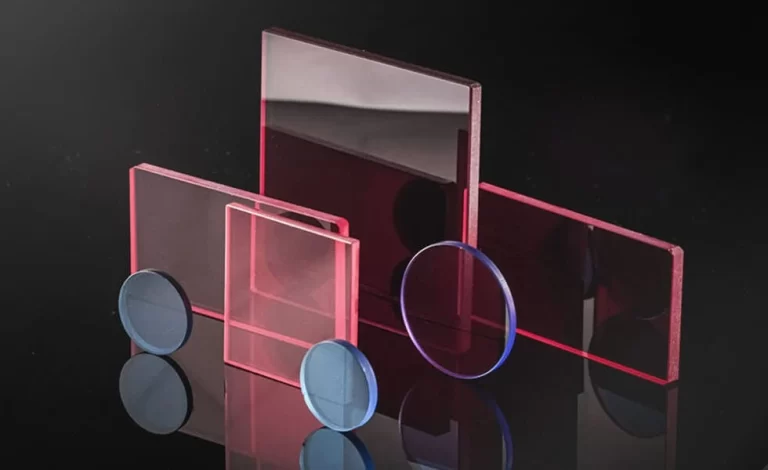
Shanghai Optics colored glass filters are high quality absorption filters made of colored glass. They allow certain wavelengths of light to pass unimpeded, while blocking other wavelength ranges to a designated extent. Rather than using thin film coatings to achieve filtering effects, these filters rely on the absorption and transmission properties of the color glass. Precision can be achieved through careful control of the thickness of the material as well as of the concentration of color used. Colored glass filters are often categorized as longpass, shortpass, or bandpass.
Colored Glass Longpass Filters
| Transmitted Wavefront Error | λ/2 @ 633nm (25mm2 area) |
| Parallelism | < 1 arcmin |
| Surface Quality | 40-20 |
| Dimension Tolerance | +0.0/-0.2mm |
| Thickness Tolerance | 2mm ±0.2mm |
| Center Wavelength Tolerance | ±10nm |
| Transmission | Tavg>85% |
| Cut-On Wavelength | Transmission increases to 50% |
| Cut-On Wavelength (nm) | Filter Color | Part Number | Request Quote |
|---|---|---|---|
| 280 | Clear | SO-CG-FIL-EI12C-0141 | Request a Quote |
| 320 | Clear | SO-CG-FIL-EI12C-0142 | Request a Quote |
| 375 | Clear | SO-CG-FIL-EI12C-0143 | Request a Quote |
| 395 | Clear | SO-CG-FIL-EI12C-0144 | Request a Quote |
| 420 | Yellow | SO-CG-FIL-EI12C-0145 | Request a Quote |
| 435 | Yellow | SO-CG-FIL-EI12C-0146 | Request a Quote |
| 455 | Yellow | SO-CG-FIL-EI12C-0147 | Request a Quote |
| 475 | Yellow | SO-CG-FIL-EI12C-0148 | Request a Quote |
| 495 | Yellow | SO-CG-FIL-EI12C-0149 | Request a Quote |
| 515 | Yellow | SO-CG-FIL-EI12C-0150 | Request a Quote |
| 530 | Yellow | SO-CG-FIL-EI12C-0151 | Request a Quote |
| 550 | Orange | SO-CG-FIL-EI12C-0152 | Request a Quote |
| 570 | Orange | SO-CG-FIL-EI12C-0153 | Request a Quote |
| 590 | Red | SO-CG-FIL-EI12C-0154 | Request a Quote |
| 610 | Red | SO-CG-FIL-EI12C-0155 | Request a Quote |
| 630 | Red | SO-CG-FIL-EI12C-0156 | Request a Quote |
| 645 | Red | SO-CG-FIL-EI12C-0157 | Request a Quote |
| 665 | Red | SO-CG-FIL-EI12C-0158 | Request a Quote |
| 695 | Black | SO-CG-FIL-EI12C-0159 | Request a Quote |
| 715 | Black | SO-CG-FIL-EI12C-0160 | Request a Quote |
| 780 | Black | SO-CG-FIL-EI12C-0161 | Request a Quote |
| 850 | Black | SO-CG-FIL-EI12C-0162 | Request a Quote |
| 1000 | Black | SO-CG-FIL-EI12C-0163 | Request a Quote |
Colored Glass Bandpass Filters
| Material | Colored Glass |
| Transmitted Wavefront Error | λ/2 @ 633nm (25mm2 area) |
| Parallelism | < 1 arcmin |
| Surface Quality | 40-20 |
| Dimension Tolerance | +0.0/-0.2mm |
| Thickness Tolerance | 2mm ±0.2mm |
| Center Wavelength Tolerance | ±10nm |
| Center Wavelength | Midpoint of transmission band |
| Center Wavelength (nm) | Filter Color | Part Number | Request Quote |
|---|---|---|---|
| 318 | Black | SO-CG-FIL-EI12C-0164 | Request a Quote |
| 325 | Black | SO-CG-FIL-EI12C-0165 | Request a Quote |
| 355 | Black | SO-CG-FIL-EI12C-0166 | Request a Quote |
| 356 | Black | SO-CG-FIL-EI12C-0167 | Request a Quote |
| 400 | Black | SO-CG-FIL-EI12C-0168 | Request a Quote |
| 410 | Blue -Violet | SO-CG-FIL-EI12C-0169 | Request a Quote |
| 470 | Blue-Green | SO-CG-FIL-EI12C-0170 | Request a Quote |
| 507 | Blue-Green | SO-CG-FIL-EI12C-0171 | Request a Quote |
| 510 | Clear | SO-CG-FIL-EI12C-0172 | Request a Quote |
| 530 | Clear | SO-CG-FIL-EI12C-0173 | Request a Quote |
Shanghai Optics colored glass filters are high quality absorption filters made of colored glass. They allow certain wavelengths of light to pass unimpeded, while blocking other wavelength ranges to a designated extent. Rather than using thin film coatings to achieve filtering effects, these filters rely on the absorption and transmission properties of the color glass. Precision can be achieved through careful control of the thickness of the material as well as of the concentration of color used. Colored glass filters are often categorized as longpass, shortpass, or bandpass.
Longpass filters effectively block shorter wavelengths of light while freely transmitting longer wavelengths. These filters are described by cut-on wavelength at 50 percent of peak transmission. We manufacture longpass filters with sharp cut on wavelength and high rejection/transmission efficiency, for UV, Vis, or IR pass ranges.
Our shortpass colored glass filters transmit short wavelengths of light while restricting long wavelengths. They can be used to improve contrast and resolution, or to separate colors in black and white.
Bandpass filters, which transmit only a certain wavelength and block all others, are described by the wavelength range that is transmitted. Typically this band of light, known as the band pass, has a bandwidth of one to several hundred nanometers. These optical filters have a wide range of possible uses, and are ideal for environmental testing, clinical chemistry, imaging, spectroscopy, or fluorescence microscopy.
Bandpass filters that are designed for the ultraviolet spectrum filter light with wavelengths from around 4 to 380 nm. For the visible spectrum, target wavelengths will be 380 to 750 nm, and for infrared filtering you will need a bandpass filter that operates on wavelengths from around 750 to 2500 nm.
Important Filter Specifications
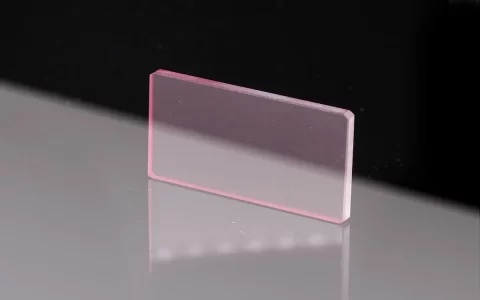
There are three filter specifications important to keep in mind as you select the ideal colored glass filter for your application. These are central wavelength (abbreviated CW), full width at half maximum (FWHM), and peak transmittance (Tpk).
Full width at half maximum, also known as the filter’s bandwidth, is defined to be the range of wavelengths which are passed through the filter when the transmission value is at 50% of minimum. Center wavelength refers to the midpoint of that bandwidth. And peak transmittance tells us the maximum percentage of transmitted light through the passband.
As an example, consider a filter with a central wavelength of 600 nm and a FWHM of 10 nm. This filter will only transmit light between 595 and 605; yellow light on the visible spectrum.
Another parameter useful to keep in mind is the optical density of a filter. This number describes how effective the filter is in blocking undesired wavelengths. Optical density is the negative log of the transmission percentage, over 100. The higher the optical density number the better that particular filter is in blocking all undesired light.
Classic color filters are simple filters which allow up to 90 percent of their own color to pass through while essentially filtering outall other wavelengths of light. They are often used in monochrome camera imagery in order to separate out colors and create easily differentiable images.
For instance, in a monochrome image of a collection of red and green items it will be impossible to differentiate the colors if they are similar in darkness and saturation. However, if a red color filter is added to the imaging setup, red items will be lightened and green darkened. This allows the distinction between the two items to appear clearly even in the monochrome image.
Related Content
Optical Components
Need help?
We offer consultations and initial feasibility studies. If you have questions about limitations or lens capabilities we’re more than happy to work through your proposed custom components. As an unmatched custom optical provider, we’ll do everything that we can bring your vision to life.


