


Narrowband Optical Filters
Narrowband optical filters selectively transmit a narrow wavelength range while blocking unwanted light. These filters are widely used in astronomy, spectroscopy, fluorescence imaging, remote sensing, and scientific instrumentation.
Narrowband filters, as the name implies, are filters that only allow a narrow range of frequencies to pass through while blocking all other frequencies. This is a direct contrast to broadband filters, enabling a wide range of frequencies while blocking unwanted ones.
As mentioned before, there are common applications where the need to isolate specific spectral features and filter out unwanted light is required. These include scientific, industrial, and medical settings. In general, manufacturers ensure high precision and accuracy when making the narrowband filter. This is because they are often integrated with other optical components to achieve specific performance requirements.
Types of Narrowband Filters?
Narrow Bandpass Filters: Narrow bandpass optical filters are designed to isolate a narrow wavelength range while blocking surrounding wavelengths. These filters allow a specific range of frequencies to pass through while blocking all other frequencies. They are commonly used in spectroscopy, fluorescence imaging, telecommunications, and scientific instrumentation. Optical bandpass filters can be designed with different bandwidths, center wavelengths, and attenuation levels depending on system requirements.
Interference filters: Interference filters, also known as Fabry-Pérot filters, use multiple dielectric thin-film layers to selectively transmit specific wavelengths while blocking unwanted light. These optical filters are commonly used in spectroscopy, fluorescence microscopy, laser systems, and precision optical instrumentation.
Cavity filters: Cavity filters are narrowband optical filters designed for microwave, RF, and precision wavelength-selection applications. These filters use resonant cavity structures to selectively transmit frequencies within a narrow spectral bandwidth.
Crystal filters: Crystal filters use quartz or other crystal materials to isolate specific frequencies within a narrow bandwidth. They are commonly used in radio communication systems, signal processing, and precision frequency filtering applications.
Applications of Narrowband Optical Filters
These filters particularly come in handy when the signal of interest is weak and needs to be separated from background noise or other unwanted light.
Astronomy
Narrowband optical filters are widely used in astronomical imaging systems to isolate specific emission lines and improve contrast in astrophotography and spectroscopy applications.
These filters help analyze the composition, temperature, density, and motion of celestial objects by isolating targeted wavelengths.
Remote Sensing
Narrowband optical filters are used in remote sensing systems to isolate specific spectral signatures for environmental and atmospheric analysis.
Typical applications include satellite imaging, lidar systems, pollution monitoring, and thermal analysis.
Medical Imaging
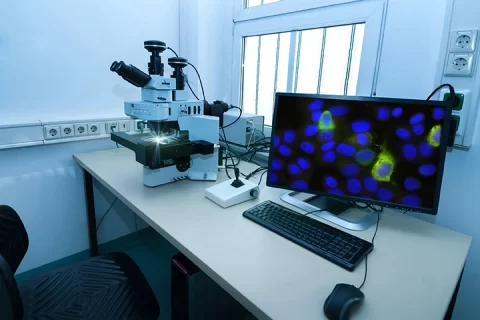
Narrowband optical filters are widely used in fluorescence microscopy, Raman spectroscopy, and biomedical imaging systems.
These filters help isolate specific wavelengths for improved contrast, molecular detection, and cellular analysis.
Telecommunications
Narrowband optical filters are applied in WDM and DWDM optical communication systems for wavelength isolation and signal management.
These filters help reduce optical noise and improve signal transmission efficiency in fiber-optic networks.
Why Do Astronomers Use Narrowband Filters?
Narrowband imaging systems use optical filters to isolate specific emission lines from gases in astronomical objects.
By isolating targeted wavelengths, astronomers can improve image contrast and analyze the spectral characteristics of stars, nebulae, and galaxies.

This method helps astronomers better comprehend the properties and operations of celestial objects.
In other words, they may learn more about how stars, galaxies, and other planetary systems develop and evolve by looking at the intensity and distribution of emission lines, which can show the temperature, density, and velocity of ionized gas in nebulas.
In other words, they may learn more about how stars, galaxies, and other planetary systems develop and evolve by looking at the intensity and distribution of emission lines, which can show the temperature, density, and velocity of ionized gas in nebulas.
Custom Narrowband Optical Filter Solutions
Shanghai Optics manufactures high-performance narrowband optical filters for spectroscopy, fluorescence imaging, astronomy, remote sensing, and scientific instrumentation.
Custom narrowband filters can be designed for specific wavelength ranges, bandwidths, coating requirements, and optical system integrations.
Contact our engineering team to discuss your narrowband optical filter requirements.


