

Design Principles of Infinite Conjugate Microscope Objectives
Design Principles of Infinite Conjugate Microscope Objectives
Designing an infinity-corrected microscope objective requires engineers to balance numerical aperture, working distance, aberration correction, and optical path integration. This guide explains the key engineering considerations behind custom microscope objective design and how Shanghai Optics optimizes complete optical systems for life science, semiconductor, and industrial imaging applications.
Unlike traditional finite-conjugate objectives, infinity-corrected designs create a parallel (collimated) light path between the objective and tube lens. This “infinity space” allows beam splitters, dichroic mirrors, filter cubes, and other optical components to be integrated without shifting the focal plane, making these objectives ideal for complex imaging systems.
Shanghai Optics designs and manufactures standard and custom infinity-corrected microscope objectives, combining optical engineering, precision manufacturing, and system-level optimization to support life science, semiconductor, and industrial imaging applications.
Key Engineering Considerations for Infinity-Corrected Microscope Objectives
1. Engineering the Infinity Space
In an infinity-corrected system, the objective projects image-space light to infinity, and a secondary custom tube lens focuses the collimated beam bundle onto the intermediate image sensor plane.
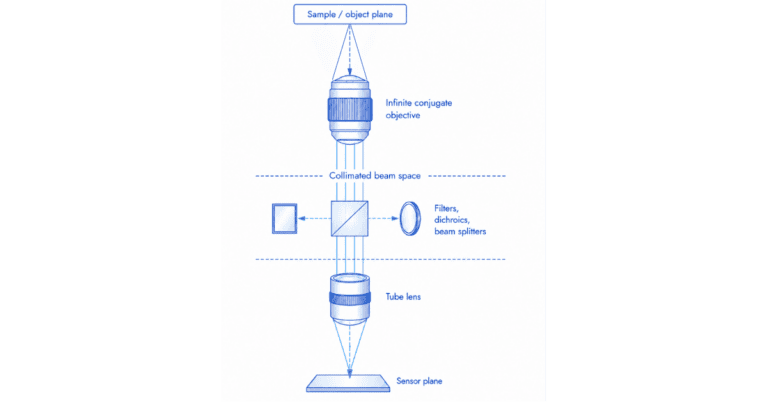
While the collimated path offers modular flexibility, the infinity space is not infinitely expandable. Off-axis marginal rays exit the rear aperture of the objective at an angle θ. If the physical distance (L) between the objective rear pupil and the tube lens is too long, edge rays clip against the clear aperture of the tube lens, resulting in severe peripheral vignetting.
Maximum Allowable Infinity Space
Where:
- DTL = Clear aperture of the tube lens
- DEP = Exit pupil diameter of the objective
- θ = Maximum off-axis field angle
During the design process, Shanghai Optics evaluates infinity space together with tube lens selection and system packaging to help prevent vignetting while maintaining flexibility for filters, beamsplitters, and other optical components.
System-Level Optical Design
Rather than optimizing the objective lens as an isolated component, Shanghai Optics considers the complete optical system during the design phase. Using CODE V and Zemax optical simulation, our engineers evaluate exit pupil location, chief ray angles, tube lens compatibility, and sensor size to help minimize vignetting while supporting complex optical assemblies.
This system-level optimization enables the integration of filters, dichroic mirrors, beam splitters, and other optical components without compromising imaging performance.
2. High Numerical Aperture vs. Working Distance
System resolution (d) is governed by Abbe’s diffraction limit:To achieve lateral resolutions below 200 nm, high-performance objective designs demand:
- NA ≥ 0.95 in air
- NA ≥ 1.45 in oil or water immersion
However, increasing the light-gathering angle (θ) naturally compresses the physical Working Distance (WD). In semiconductor inspection or microfluidic analysis, insufficient working distance risks physical collisions between the objective barrel and sample topography.
Optical Architecture Comparison
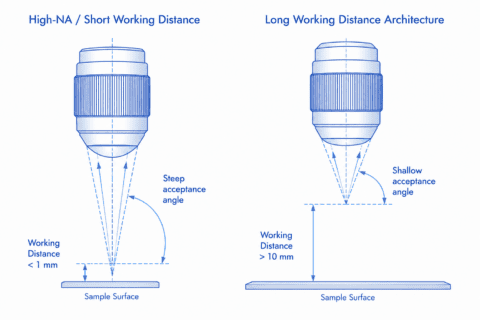
To maintain edge-to-edge image flatness across large sensor formats (e.g. Ø25 mm image field) without sacrificing working distance, advanced optical element stacks are required.
Designing an Infinity-Corrected Objective?
Work with our engineers to optimize your microscope objective for your specific application.
Contact Our Engineers
Plan-Apochromatic Correction
Plan-Apochromatic objective designs incorporate Fluorite (CaF₂) and extra-low dispersion (ED) glass elements to focus three wavelengths (typically 435 nm, 546 nm, and 656 nm) onto a single focal plane, virtually eliminating secondary spectrum chromatic aberration.
Extended UV and SWIR Design
For applications ranging from 200 nm to 14 μm, conventional organic adhesives inside cemented doublets degrade under high laser energy or prolonged UV exposure.
For specialized UV, DUV, and high-power laser applications, Shanghai Optics develops custom reflective or hybrid optical architectures when conventional cemented lens assemblies are not suitable.
Application-Specific Objective Optimization
Every imaging application requires a different balance between numerical aperture, working distance, wavelength range, and mechanical constraints. Shanghai Optics develops custom infinity-corrected objectives by optimizing these parameters simultaneously rather than maximizing a single specification.
Using optical simulation and tolerance analysis, our engineers tailor each objective to the customer’s sensor format, illumination wavelength, and system architecture to achieve practical, manufacturable solutions.
Optical Performance Verification
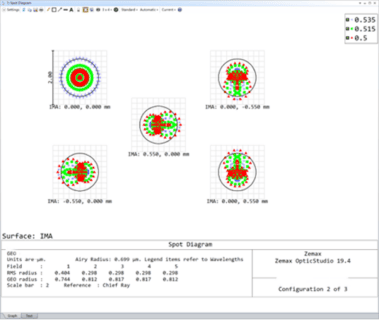
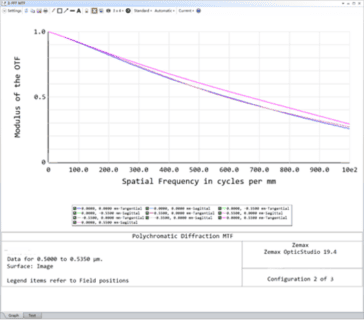
Before a custom microscope objective enters manufacturing, its optical performance should be verified through simulation and tolerance analysis. Shanghai Optics uses CODE V and Zemax to evaluate image quality, aberration correction, modulation transfer function (MTF), spot size, and manufacturing tolerances throughout the design process. This helps ensure the final objective achieves the required resolution, contrast, and field performance before production begins.
3. Sub-Micron Optomechanical Engineering
An outstanding optical prescription will fail if mechanical mounting introduces element tilt or thermal drift. High-NA infinite conjugate microscope objectives typically contain 8–14 precision lens elements housed within tightly toleranced mechanical barrels.
Precision Manufacturing and Assembly
- Coaxial Alignment & Centering
The imaging performance of a microscope objective depends not only on its optical design but also on the precision of its mechanical assembly. Shanghai Optics carefully controls lens alignment, spacing, and centering throughout the assembly process to preserve the intended optical performance.
Precision CNC-machined housings provide accurate concentricity between optical and mechanical reference surfaces, supporting stable alignment and repeatable manufacturing across prototype and production builds.
- Standardized & Custom Mounting Interfaces
To simplify system integration, Shanghai Optics offers microscope objectives with industry-standard mounting interfaces, including RMS, M25 × 0.75, and M32 × 0.75. Custom mechanical interfaces are also available for OEM equipment and specialized optical systems.
- Athermalization for Cleanroom & Field Reliability
Environmental temperature changes produce differential thermal expansion between optical glasses and metallic housings (aluminum, brass, or Invar).
Shanghai Optics can incorporate temperature-compensated mechanical designs for applications that require stable optical performance under varying environmental conditions.
From Design to Production: Why Engineering Teams Partner with Shanghai Optics
Developing a high-performance microscope objective requires the integration of optical design, precision manufacturing, and rigorous quality verification. Shanghai Optics combines optical engineering, precision manufacturing, and quality verification to support customers throughout the entire product development cycle—from concept and prototype development to production manufacturing.
Our integrated capabilities include:
- Custom optical design using CODE V and Zemax
- Optical optimization for UV, VIS, NIR, and SWIR applications
- Precision lens fabrication and polishing
- Broadband and laser-grade anti-reflection coatings
- Precision CNC-machined mechanical housings
- Multi-element optical assembly and alignment
- Optical metrology, including interferometry and MTF testing
- Prototype development through production manufacturing
Custom Design Options
Shanghai Optics can customize key optical and mechanical parameters to meet specific application, integration, and environmental requirements.
| Parameter | Custom Options |
| Magnification | 2×–100× |
| Numerical Aperture | Application-specific |
| Working Distance | Short, medium, long |
| Wavelength | UV, VIS, NIR, SWIR |
| Correction | Achromat, Plan, Plan Apo |
| Tube Lens | 180 mm, 200 mm, custom |
| Mount | RMS, M25, M32, custom |
| OEM Branding | Available |
Design a Custom Microscope Objective for Your Application
Every imaging system has unique requirements for magnification, numerical aperture, wavelength range, working distance, and mechanical integration. Whether you’re developing a fluorescence microscope, semiconductor inspection system, or industrial vision platform, Shanghai Optics can help optimize your objective from initial optical design through precision manufacturing and production.


